Chapter 18
Sandals enthroned
 On the sixth day of
their stay, Bharatha called together, after
the morning rites, bath and devotional
ceremonies like the worship of the Dawn, his
brother Satrughna and his own aides and
followers. He watched for a favourable moment
to accost Rama and when he found one, he rose
suddenly from his seat and mustered sufficient
courage to lay himself prostrate at his feet.
Standing in front of him with his palms
folded, Bharatha prayed thus: "O, Mark of
Auspiciousness on the brow of the Royal
Ikshvaku line! You have fulfilled my desires
in every way. On my account, you have
determined to suffer miseries of all kinds.
You are undergoing all types of troubles for
my sake. Lord! I am awaiting your commands.
For fourteen years, I shall be awaiting your
return and serving you in the kingdom. Show me
the path by which I can feast my eyes on your
Lotus Feet when the period of exile ends.
Teach me the courage I need to survive these
fourteen years of separation. Rama! Your
subjects, their families, the people residing
in the vast Empire, the Brahmins, the Pundits
-- all are spiritually earnest; they are bound
to you by feelings of reverential devotion.
They are bearing the pangs of misery buoyed up
by the love you bear unto them. I care not
even for the attainment of self-realization
if, to attain it, I am separated from you. You
are aware of the inner feelings of your
servants; you know their deepest desires. You
can guide me and lead me to the goal, here and
hereafter. This conviction is the sustenance
and strength on which I exist. On account of
this conviction, I treat all this agony as
just shriveled blades of grass. Till now I
elaborated before you my sorrow as if they
were burdening my head. That was a failing on
my part; do not hesitate to reprimand me for
this fault."
On the sixth day of
their stay, Bharatha called together, after
the morning rites, bath and devotional
ceremonies like the worship of the Dawn, his
brother Satrughna and his own aides and
followers. He watched for a favourable moment
to accost Rama and when he found one, he rose
suddenly from his seat and mustered sufficient
courage to lay himself prostrate at his feet.
Standing in front of him with his palms
folded, Bharatha prayed thus: "O, Mark of
Auspiciousness on the brow of the Royal
Ikshvaku line! You have fulfilled my desires
in every way. On my account, you have
determined to suffer miseries of all kinds.
You are undergoing all types of troubles for
my sake. Lord! I am awaiting your commands.
For fourteen years, I shall be awaiting your
return and serving you in the kingdom. Show me
the path by which I can feast my eyes on your
Lotus Feet when the period of exile ends.
Teach me the courage I need to survive these
fourteen years of separation. Rama! Your
subjects, their families, the people residing
in the vast Empire, the Brahmins, the Pundits
-- all are spiritually earnest; they are bound
to you by feelings of reverential devotion.
They are bearing the pangs of misery buoyed up
by the love you bear unto them. I care not
even for the attainment of self-realization
if, to attain it, I am separated from you. You
are aware of the inner feelings of your
servants; you know their deepest desires. You
can guide me and lead me to the goal, here and
hereafter. This conviction is the sustenance
and strength on which I exist. On account of
this conviction, I treat all this agony as
just shriveled blades of grass. Till now I
elaborated before you my sorrow as if they
were burdening my head. That was a failing on
my part; do not hesitate to reprimand me for
this fault."
Hearing this,
the gathering hailed his statements and
expressed their appreciation. As the Hamsa,
Celestial Swan, is able to separate the milk
from the water which is mixed with it and
drink just the milk, so, they said, Bharatha
had separated the Truth from untruth and given
expression to the Truth alone.
Rama,
compassionate towards the distressed, listened
to those words poured from the pure heart of
his brother. Rama replied thus, in conformity
with the place, the time and the circumstance:
"Brother! For you who reside at home, and for
us who reside in the forest, there is the One
who fosters all, to foster and fend. You have
in a worldly practical sense, the Perceptor
Vasishta and the Emperor Janaka as guardians
and guides. No trouble can bother either you
or me, even in our dreams; no, it can never
happen. The highest duty for us is to carry
out strictly the commands of our father; that
alone can confer on us all the good we long
for; that alone can enable us to earn lasting
renown. That path is the one approved by the
Vedas. The Vedas declare that whoever reveres
the commands of the preceptor, the father and
the mother and walks on the right path, is the
noble example for all.
"Be ever aware
of this truth; throw away the shroud of grief;
take up the burden of Empire; rule over it for
14 years with justice and rectitude as your
ideals. The King is the face of the State.
For, the face eats and drinks and thus
strengthens and activates all the limbs of the
body. The King feeds and sustains every
section of his people. The mind encloses
within itself all likes and dislikes; so too,
the King is the repository of all moves and
movements in the political field". Rama
expounded many a useful doctrine of political
ethics to Bharatha. But, Bharatha was too
agitated to earn mental peace as a result of
Rama's advice. The mothers, teachers, and
ministers stood benumbed, for they too were
overcome by the imminence of the moment of
parting. Suddenly, Rama in his infinite
Graciousness loosened his sandals and gave
them to Bharatha. And, Bharatha reverentially
accepted them in his palms and placed them in
his head. Tears streamed from his eyes, like
the twin rivers, the Ganga and the Yamuna.
Bharatha could
not express his joy in words. "These are not
the 'sandals' worn by the Ocean of Mercy!
These are the guardians of the lives and
prosperity of all mankind. These are the
chests enclosing the precious treasure of
Rama's brotherly love. They are the protecting
doors of the fort which enshrines the royal
fame of the Raghu clan. These are two hands
that are ever engaged in good deeds. These are
the veritable eyes of the Universe. These are
the symbols of Sita and Rama who are coming
with us as these two".
Bharatha
extolled the 'sandals' thuswise and danced
around them in sheer joy and thankfulness. All
present fell at the feet of Rama and
acknowledged the sublimity of Rama's Grace.
Bharatha
prostrated before Rama and prayed that he
might grant him permission to leave. Rama
appreciated the spirit of contentment with
which he welcomed the 'sandals'; he drew
Bharatha near and embraced him fast and firm
with great affection and delight. Satrughna
also fell at Rama's feet; Rama embraced him
with great affection and he communicated to
him also many a directive for ruling the
kingdom and carrying out the duties devolving
on him. Consider Bharatha as Rama himself, he
told him. "Be his support and counsel and help
him to establish peace and prosperity in the
Empire".
Then, Bharatha
and Satrughna embraced Lakshmana in fraternal
love, saying, "Brother! Your luck is indeed
great. Yours is the best of luck. In all
worlds there is none so fortunate as you."
They praised Lakshmana to their hearts'
content and took permission to depart.
Lakshmana too called them near and told them
that the 'sandals' of Rama are the springs of
all varieties of auspiciousness and so, they,
who have won that gift, were indeed more
fortunate than any. He advised them to act
worthy of the gift and earn the Grace of Rama
forever. "That is your duty now", he reminded
them.
Later the
brothers proceeded to where Sita was and fell
at her feet. On seeing her, they could not
contain their grief; they burst into sobs. She
consoled them softly and sweetly in various
ways. "Is there naught else than the armour of
Rama that can protect any one in the world?
You are indeed blessed. The fourteen years
will roll by as swift as fourteen seconds, and
the Empire will smile in plenty and peace with
the return of Rama. Carry on the
administration with patience and devotion;
don't deviate a little from the guidelines he
has marked out. By this rigorous obedience you
will be able to secure the fruits of your
desires."
Then the
brothers, Bharatha and Satrughna, went
straight to Emperor Janaka and fell at his
feet in exemplary reverence and said, "Lord!
You have such compassion on us that you came
to Ayodhya when you heard about the death of
our father and of the exile of Rama in the
forest. You observed our plight with your own
eyes and comforted us during those critical
days. You gave us appropriate advice to
resuscitate ourselves. In order to fulfill
your inner desire, you subjected yourself to
all this strain and trouble, coming over here
into this jungle. You have shared with us our
grief and contributed your valuable part in
the pleading we made to Rama to persuade him
to return. When those pleadings failed, you
consoled us and taught us to bear the
disappointment and distress, and enriched us
with your blessings. We offer our reverential
gratitude. What more can we say or do? Your
blessings are the most effective
reinforcements we require". Janaka listened to
these words uttered so sincerely and so
thankfully by the two brothers. He appreciated
their reactions and feelings, their character
and conduct; he drew them near himself and he
lovingly caressed them and stroked their
heads.
He said, "Sons!
May you walk along the path laid down by Rama
and may you thereby win his Grace. I am
proceeding to Mithila straight from here". The
ministers, feudatory rulers, Brahmins, sages,
ascetics, and others who had come with the
brothers, went one after another towards Rama,
Lakshmana and Sita, and falling at their feet,
they took leave of them and turned their faces
homeward, their hearts heavy with a sense of
gloom. Sita, Rama and Lakshmana went to where
the mothers were and prostrated before them.
They consoled them, saying, "Do not worry in
the least. Be engaged in the correct
performance of your duties and
responsibilities. Have before you ever the
wishes and ideals that father has laid before
us". As for themselves, they said they would
be spending happily and peacefully the period
of fourteen years as a quick span of fourteen
seconds, and returning joyfully to Ayodhya.
These words restored the spirits of the
queens.
They fell at the
feet of Kaikeyi and told her that she had not
an iota of responsibility for the exile of
Rama into the forest and that she was ever
worthy of their reverence and worship. She had
never intended any harm, they said. They
assured her that they would ever pray for her;
they pleaded with her that she should not have
the least worry over them in the forest. They
gave her a great deal of courage to bear her
burden of repentance. "Bharatha had spoken
rashly and impertinently, in a fit of
senseless fury, when he was suddenly
confronted with the two calamities: the death
of his father and exile of his brother. He
flew into a passion, for his blood boiled at
the person he imagined was responsible for
these events. He did not even care for the
fact that you were his mother!" Rama, Sita and
Lakshmana prayed that she should not blame
Bharatha for that incident; they begged her to
pardon Bharatha for the indiscretion.
While Rama was
speaking thus, Kaikeyi was downcast with shame
at the memory of her iniquity. She could not
look Rama in the face. She felt within
herself, "Alas, that I should be the cause of
inflicting so much misery and suffering on
this son endowed with a heart of compassion
and a mind full of virtues, a son who is
unalloyed gold, nothing less. Am I not the
reason for him to spend his years in this
terrifying jungle? O, what a devilish deed did
I perpetrate? But, did I do it on my own? Or,
was it Rama that willed the turn of events
through my instrumentality? Whatever the
truth, I cannot escape; I have committed the
gravest sin".
Kaikeyi was
overcome with sorrow over the irrevocable
past; she held both hands of Sita in her grasp
and petitioned for pardon. Soon, she added,
"No. No. It is not just that you pardon a
sinner who brought about such unbearable
travail on such a pure and tender woman." She
continued to lament her misfortune for long.
Every one who had come from Ayodhya took leave
of Sita, Rama and Lakshmana as and when they
could get the chance. Afterwards, they
ascended their chariots in due order.
Sita, Rama and
Lakshmana approached each chariot before it
left and consoled and comforted each occupant
and persuaded them to leave. Sita, Rama and
Lakshmana fell at the feet of the Preceptor,
and apologized to him, saying that they had
caused him and his consort a lot of trouble;
they expressed sorrow that they could not
serve them as well as they wished to, and as
their duty demanded. Then they asked
permission to stay back.
Vasishta was of
course a Brahmajnani and a Maharshi; so
he could know the inner feelings of Sita and
others. He appreciated the devotion and
humility of the brothers and Sita and their
strict adherence to the path of Dharma.
Vasishta and his consort could not leave the
presence of Rama, for they were so attached to
the virtues he embodied. The picture of those
three standing by the side of the jungle track
with folded palms, bidding adieu to each
passing chariot and the people inside, melted
the most adamantine heart. Vasishta and his
consort, Arundhati, were very much moved at
the sight of their large hearted sympathy.
Then, Rama saw
the chieftain of the Nishadas standing before
him, amidst his followers. He went forward to
him and extending his arms, he embraced him,
more warmly than when he clasped to his bosom
his own brother. He consoled Guha, with
affectionate appeals to calm himself and
persuaded him to accept the separation wisely.
Guha could not do anything to change the turn
of events; so he fell at the feet of Rama, and
rose with a heavy heart, and walked off, with
his eyes fixed on Rama for as long as he could
catch sight of that picture of charm.
Sita, Rama and
Lakshmana stood under a spreading tree, until
the last of them left. Meanwhile, Emperor
Janaka also prepared to leave, at the head of
his party, for Mithila. Rama and Lakshmana
prostrated before their father-in-law and
mother-in-law; Sita fell at the feet of her
parents. The parents embraced her and stroked
her head in fond tenderness. They said,
"Daughter! Your courageous determination and
your devotion towards your husband will bring
us great renown. Through you, our family and
clan have been rendered holy. We must have
accomplished some great vow and fulfilled some
great austerity or else you would not have
been born in lour line". They extolled her in
profuse terms and expressed their joy and
exultation. They assured her, "Sita! You can
suffer no want; Rama is the breath of your
existence. We know that since you live in his
shade, no harm can touch you. However, as a
result of you two being different entities,
problems and perplexities might now and then
confront you. Those are but the play of
destiny, just passing clouds". Janaka
presented before them many Vedantic truths to bring them
comfort and contentment. Then, he too left the
hermitage and took the track that led him out
of the forest.
Sita, Rama and
Lakshmana stood in the shade of that tree,
until the people from both Ayodhya and Mithila
went beyond the range of their eyes. Then,
they returned to their thatched cottage, and
there, while Rama was describing with
appreciative ardour, the devotion and faith of
Bharatha and Satrughna, their exemplary love
and loyalty, and the affectionate attachment
of the subjects of the Empire, Sita and
Lakshmana listened attentively and echoed the
same sentiments. Their hearts felt sore at
their departure; they would fain have liked
their presence longer. Often during the talk,
they remembered the death of Dasaratha and
tears rolled down their cheeks as they
recalled the Emperor's affection towards them.
Seeing their plight Rama's face was lit up
with a smile; he expatiated on the mystery of
life and the key to its unraveling. Thus, they
spent that eventful day, in the silence of
that sylvan retreat.
Meanwhile, the
stream of people emerging from the edge of the
forest towards the populated areas near
Ayodhya -- the ascetics, the sages, the
Brahmins, the brothers Bharatha and Satrughna,
the queens Kausalya, Kaikeyi and Sumitra, the
ministers and the vast mass of citizens --
could not contain the burden of sorrow, which
became heavier the farther they went, and the
nearer they approached the City. They spent
the time describing to each other the events
of the five days they had spent in Rama's
presence, and admiring the ideals that Rama
had embodied and exemplified and his love,
compassion and affection. They did not halt
anywhere for food or even for sleep, since
they felt neither hunger nor the prompting of
sleep. Sorrow at the separation had
overwhelmed and put to flight all minor
insufficiencies.
The second day,
they encountered the mighty Ganga river; the
Chieftain of the Nishadas arranged boats to
row them across and also prepared plentiful
repast for the tired populace and for the
distinguished persons from the Court. But, no
one partook of the hospitality he provided,
for their grief at having come away from Sita,
Rama and Lakshmana lay too heavy on their
hearts. Unable to displease Guha and unwilling
to wound him, they just sat before the plates,
fingered the items and getting up soon, threw
the contents away. Why? Even the horses had no
wish to feed. They just refused. Vasishta, the
Royal Preceptor noticed this, and he said,
"See! Rama is the inner Resident, the Atma that is in all; He
is the Intelligence, the Awareness that marks
out each Being".
They had no
inclination to turn aside in order to snatch a
few hours of rest. Bharatha had resolved to
travel straight to Ayodhya and not delay on
the way. He was anxious to present before the
citizens pining in Ayodhya the holy sandals of
Rama, and bring them some little comfort and
courage. So the party forded the Gomathi and
the Sarayu rivers and reached the outskirts of
Ayodhya, on the fourth day of their journey.
The aged, the
children and the women of Ayodhya who could
not join the vast assembly that marched to the
place where Rama had fixed his camp, were
watching for the signs of their happy return,
after accomplishing their mission, namely,
persuading Rama to take up the reins of
rulership. Their eyes had well nigh gone
blind, with exhaustion and extreme anxiety.
When they heard the distant whirr of chariot
wheels, they ran out into the streets and
peered into the passing vehicles, asking
"Where is our Lord?" But, since dusk soon
thickened into darkness, they went back into
their homes, and spent the night in joyous
hope that they could see their beloved Prince,
with the first rays of the rising sun. Vast
disappointment not unmixed with a little
satisfaction awaited them next morning, for,
they learnt that Rama did not return to the
Capital from the forest, but had sent instead,
the Sandals he wore, as his representative.
Meanwhile,
Bharatha called together the Royal Perceptor
and the Ministers of the Court and assigned to
them the various duties of administration. He
entrusted them with the authority to perform
their duties. He then called Satrughna near
and allotted to him the task of fostering and
consoling the queen-mothers. He arranged a
gathering of Brahmins and Pundits, and
standing before them with folded palms, he
told them that he would fulfill their wishes,
whether great or small, for he knew they would
only promote the best interests of himself and
the people. He wanted that they should place
their demands before him without hesitation.
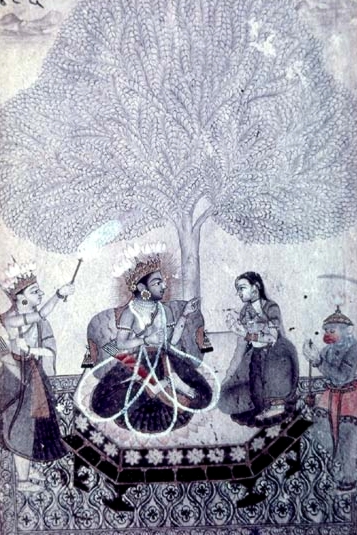
He also called
for a gathering of the citizens of Ayodhya and
the leaders of the people from all parts of
the Empire and he described before them all
that had happened in the Capital and at the
place where Rama was living in exile. He gave
them a summary of the conversations he had
with Rama, and appealed to them to adore and
revere the Sandals of Rama for the period of
fourteen years when Rama would be away, as the
authentic Presence of Rama himself. "They will
guard us all, they are our refuge and
resource", he said. "In the full confidence
that the sandals are ruling over us, let us",
he said, "live with Rama installed in our
hearts; after his return, Rama will rule over
us directly, granting us the joy of his
physical presence and direction. Our duty from
this moment is to wait for that happy day,
with prayer in our hearts".
Then, Bharatha
decided on an auspicious hour, when the Sacred
Sandals could be installed on the throne, for,
he had the joy of all classes of the
population in view, the Royal Preceptor, the
Pundits, the ascetics, the priests, the
ministers and others of the Court, the leaders
of the people and the common ranks of
citizens. He saw to it that arrangements were
made on a grand scale to celebrate the event.
That day, he
prostrated before the mothers, Kausalya,
Sumitra and Kaikeyi and then proceeded to the
Throne with the Sandals borne on his head.
Praying for the blessings of Vasishta and
permission from him and all those assembled,
he placed them on the throne, offering them
reverential loyalty. He placed all his
responsibilities safely in their custody.
Later, that
steadfast adherent of Dharma, that
incomparable hero, Bharatha walked towards the
village of Nandigrama, where he had a thatched
hut made ready for his residence. He wore his
hair braided into a knot, as Rama and
Lakshmana had done; his apparel was made of
the bark of trees, as theirs was; he lived in
a cave specially dug into the earth. His food
and dress were the same as those of the
ascetics of the forest; his acts, thoughts and
words too were austere and spiritually
oriented.
Bharatha
renounced the luxurious life of Ayodhya which
Indra, the Ruler of Heaven
praised, as unattainable by Him; he gave up
the rich life of the Royal Palace, which even
Kubera, the God of Riches envied. He was happy
in that tiny village, living unseen by others,
inside the 'grass-thatched' hut! He vowed that
he would not look at the face of any one until
Rama returned from exile. His mind was fixed
on Rama and on the day of his return from the
forest into which He had gone. His body became
weaker with every passing day. But, the
spiritual splendour on his face brightened
more and more with the passage of time. His
devotion to Rama grew to vaster and vaster
proportions. He was transformed into a pure
soul that has achieved fulfillment. In the
firmament of his heart, the stars shone in
glorious galaxies; below them, his feelings
and emotions shone like the Ocean of Milk,
calm, deep and pure.
-The End-

contents of this
Vahini | | previous page
|